The Great Wildebeest Migration
The Great Wildebeest Migration is one of the most awe-inspiring natural spectacles on Earth—a dramatic, continuous movement of over 1.5 million wildebeests, hundreds of thousands of zebras, and countless gazelles across the vast plains of Tanzania and Kenya. No other wildlife event on the planet compares to the scale, rhythm, and emotional intensity of this yearly cycle. It is a journey shaped by instinct, rain patterns, fresh grass, predators, and the timeless pulse of the African savannah.
The Epic Journey Through the Serengeti–Mara Ecosystem
The migration is not a single event, but a year-round circular movement between Tanzania’s Serengeti National Park and Kenya’s Maasai Mara National Reserve. The animals follow the rains in search of greener pastures, forming an endless loop of life, survival, birth, and death. This ancient pilgrimage has taken place for thousands of years and continues to reveal Africa’s raw beauty and drama with every passing season.
The Drama of Life and Survival
Every stage of the migration is filled with extraordinary moments:
-
newborn calves taking their first steps
-
predators hunting with precision and power
-
herds stretching across the horizon
-
frantic river crossings filled with danger
-
peaceful grazing in endless green plains
The circle of life is felt deeply here—joy, struggle, unity, and resilience all unfold in the open wilderness.
Month-by-Month Wildebeest Migration Guide
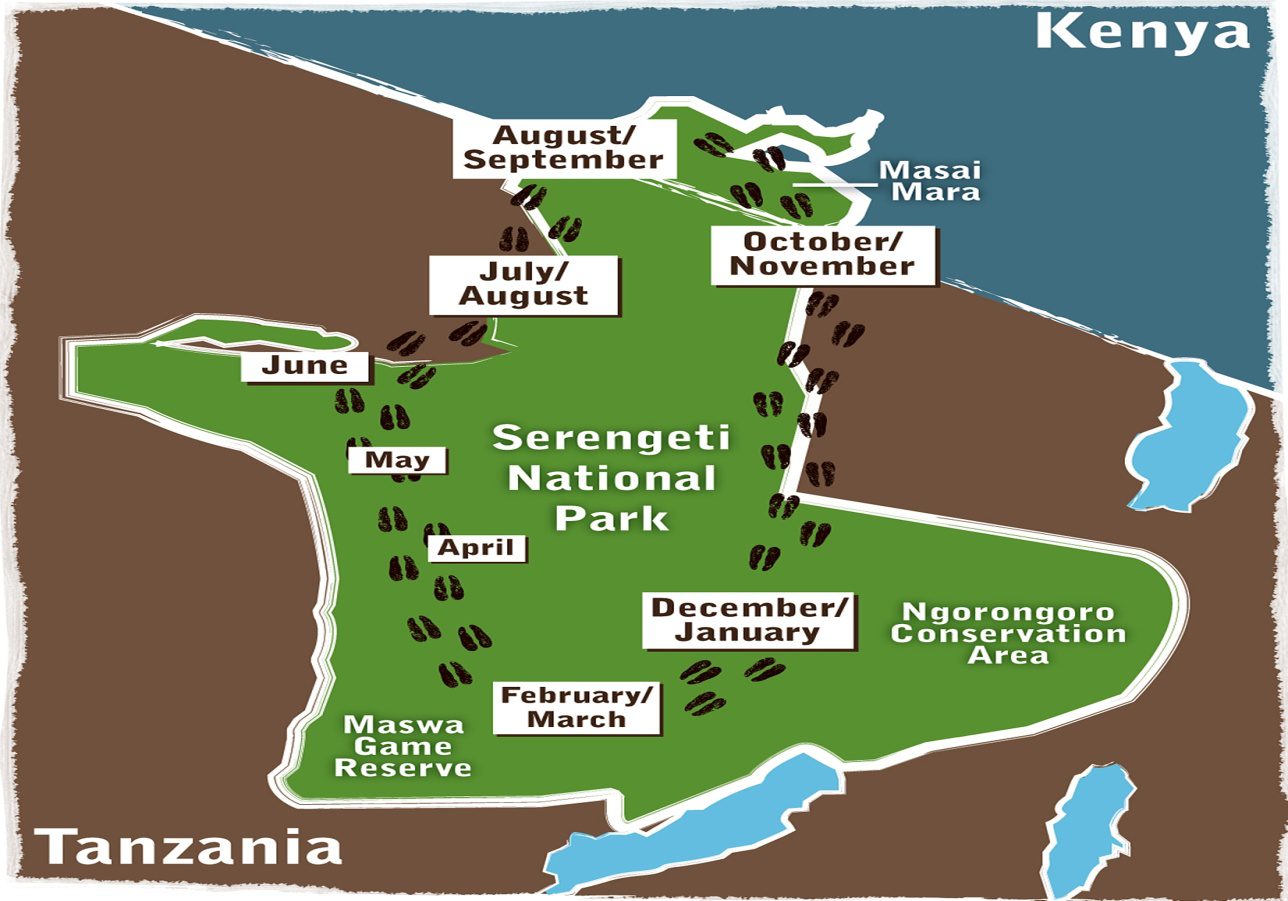
December – March: Calving Season (Southern Serengeti, Ndutu)
This is the most heartwarming and visually stunning stage.
Around 8,000 calves are born daily, filling the plains with newborn life.
The southern Serengeti and Ndutu woodlands become alive with migration herds and predators—cheetahs, lions, hyenas, and leopards—drawn by the abundance of prey.
This period offers exceptional photography, dramatic predator action, and soft green landscapes.
April – May: The Long March North (Central & Western Serengeti)
The herds begin moving slowly northward as the rains continue.
Sweeping columns of wildebeests stretch for kilometers.
The Western Corridor starts to fill with animals approaching the Grumeti River.
This is the season of wet roads, dramatic skies, and lush, peaceful scenery with few tourists.
June – July: Grumeti and the First River Crossings
As the dry season begins, the herds push toward the Western Corridor.
They gather along the Grumeti River, where enormous crocodiles lie in wait.
This is the first major challenge of the migration—and a thrilling time to witness dramatic river crossings.
July marks the movement toward the northern Serengeti.
July – October: The Mara River Crossings (Northern Serengeti & Maasai Mara)
This is the peak of migration wildlife drama.
The herds reach the Mara River, the most iconic and dangerous obstacle of the entire journey.
Thousands gather on riverbanks, anxious and restless, before plunging into the crocodile-infested waters.
This period features:
-
intense predator action
-
chaos at crossing points
-
incredible photographic opportunities
-
dramatic clashes of instinct and survival
Both the northern Serengeti and Maasai Mara offer prime viewing during these months.
October – November: Return to the Serengeti
As the short rains begin, the herds leave the Maasai Mara and migrate back south into Tanzania.
They spread out across the eastern Serengeti, grazing peacefully before returning once again to the Ndutu region for calving season.
Key Places to Witness the Migration
Ndutu – Calving Season
Best for: newborn calves, predator action, soft landscapes.
Western Corridor – Grumeti River
Best for: early river crossings, massive crocodiles, fewer crowds.
Northern Serengeti – Mara River
Best for: dramatic crossings, dense herds, intense action.
Masai Mara – Peak Season
Best for: huge concentration of herds, excellent predator sightings.
The Role of Predators
Wherever the herds move, predators follow.
The migration supports some of Africa’s largest populations of:
-
lions
-
cheetahs
-
hyenas
-
leopards
-
crocodiles
This is one of the most dramatic predator-prey systems on the planet, offering world-leading wildlife photography opportunities.
Why the Migration Matters
The migration is not just a spectacle—it is a vital ecological process.
It supports grassland regeneration, shapes predator populations, and sustains one of Earth’s most intact ecosystems.
The movement ensures that life thrives in balance across the Serengeti–Mara ecosystem.
Best Time to Visit
The best time to witness the migration depends on what you want to see:
-
Calving Season: January–March
-
Grumeti Crossings: June
-
Mara Crossings: July–October
-
Quiet Grazing & Return Journey: November
Each stage offers its own kind of magic.
Conclusion
The Great Wildebeest Migration is a timeless story of survival, unity, and destiny. Watching millions of hooves thunder across the plains, seeing predators stalk the herds, or witnessing the raw courage of river crossings is an experience that stays with you forever. It is nature at its most powerful—a living, breathing miracle that defines the spirit of African wilderness.