VEGETATION OF VOLCANOES NATIONAL PARK.
The topography of Volcanoes national park is defined by steep slopes and a variety of habitats or vegetation that are from lower montane forests/lush bamboo forests and afro-alpine forests at higher elevations which creates a complex ecology that sustains its abundant species.
The park’s abundant biodiversity and lush vegetation are a result of the nutrient-rich volcanic soils in this region hence making it an essential habitat for many animal species like the endangered mountain gorillas and golden monkeys,forest elephants, buffaloes, bushbucks, and giant forest hogs. The park is also a birding hotspot with over 180 bird species, including many endemics like the Scarlet-tufted Sunbird and the Ruwenzori Turaco.
Volcanoes National Park’s highest elevation is 4507 meters which is the Karisimbi Volcano, while its lowest point is 2400 meters. Mount Karisimbi is the highest peak in the Virunga Region and is located in Rwanda’s Volcanoes National Park it is also bordered by Democratic Republic of Congo and it takes 2 days to hike it as it rises to a height of 4507 meters. In addition to Karisimbi Volcano, there are four more volcanoes like Muhabura, Gahinga, Sabyinyo, and Bisoke that make part of the volcanoes found at Volcanoes national park.
VEGETATION RANGES OF VOLCANOES NATIONAL PARK.
The vegetation of Volcanoes national park is diverse based on the altitude of the different Volcanoes national park here we shall learn each type of vegetation found on the different mountains in Volcanoes national park based on the heights on the different ranges of these mountains.
1.Lower Montane Forest / Neoboutonia Forest (2,400m – 2,500m)
This species of woodland is located right before the Bamboo zone at the Volcanoes national park’s lowest permissible heights ranging typically from the height of 2400 to 2500 meters above sea level. The species that dominate here are the Neoboutonia trees the notable one being Neoboutonia macrocalyx which reach a height of 25 meters.
A large portion of the original the lower montane forest has been extremely diversified due to agriculture as the nearby communities have ploughed and cut down these trees to create more land for agriculture, before this area contained tropical rain forests that used to be ever green. There are also so regenerating forests that are present in this level.
2.Bamboo Forest zone(2,500m – 3,200m)
On the Volcanoes national park’s lower slopes you can also fine the Bamboo Forest, which makes up around 30% of the entire park and it is the most noticeable and vast vegetation cover. This vegetation zone ranges from the altitude of 2,500 and 3,200 meters above sea level. The dominant species include African Alpine Bamboo (Oldeania alpina, previously Arundinaria alpina) is the predominant species.
The bamboo forest have features like, it usually develops thick, nearly monospecific stands (made of almost entirely of one species) with little undergrowth, making it reasonably simple to traverse in mature stands hence supporting the easy movement of tourists during gorilla trekking. The soft, moist, and nutrient-rich volcanic soils found near the base and saddles of volcanoes like Mount Sabyinyo, Muhabura, and Gahinga provide ideal conditions for the growth of the bamboo forests.
This zone is a critically important habitat and food source for the park’s famous primates, particularly the Golden Monkey and the Mountain Gorilla, which feed extensively on the bamboo shoots hence making this zone the idea zone for mountain gorilla trekking and golden monkey trekking.
3. Hagenia-Hypericum Forest Zone (Afromontane forest)
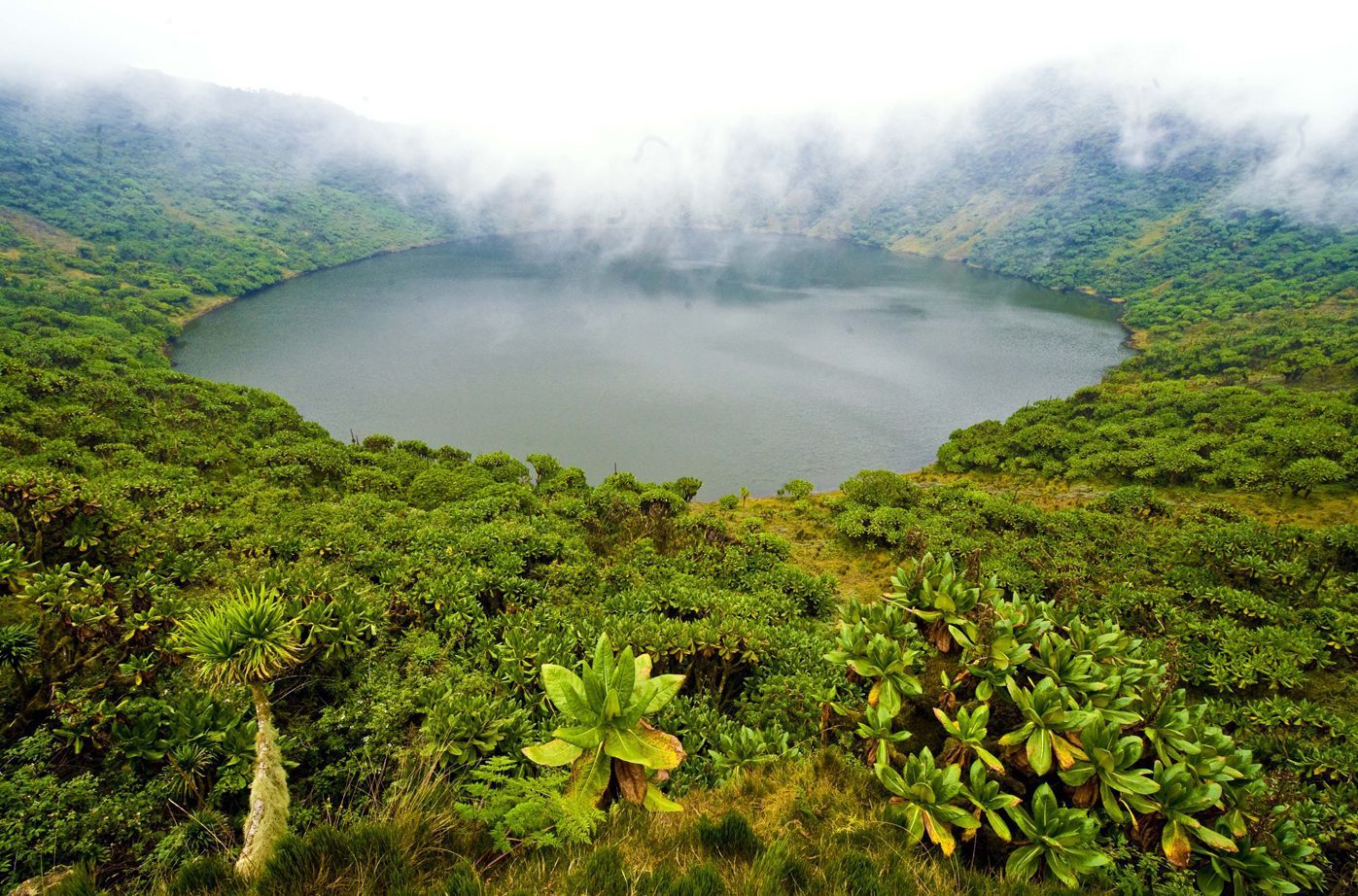
This famous forest zone makes up another 30% of the park and is mostly found on the humid south and western slopes as it frequently crosses over the upper boundaries of the bamboo and creates a unique, gorgeous woods lie between 2,600 to 3,600 metres.
The dominant species found here include:
Hagenia: The African Redwood (Hagenia abyssinica) is the dominant species, It may develop into enormous, gnarled trees with a broad, open canopy and distinctive reddish, peeling bark.
Hypericum and the huge, shrubby St. John’s Wort (Hypericum revolutum) is abundant.
Characteristic of the forest include;
Because of the heavy rainfall and steady mist, the trees are renowned densely covered with thick mosses, epiphytic ferns, and enormous lichens, giving the forest an old, fairy-tale aspect.
The open canopy provides for a rich understory of herbaceous plants, which are commonly devoured by Mountain Gorillas, making this a major foraging zone.
In areas with steeper (like Mount Sabyinyo) or drier (like Mount Muhabura) slopes, this forest may immediately give way to Ericaceous Scrub, which is dominated by giant heather.
-
Sub-Alpine Zones (Heather Belt/Ericaceous) (3,300–4,000 meters)
This region is a transitional region where temperatures decrease and harder, scrubbier vegetation is chosen by strong winds and harsh sunlight
The key Species in this zone includes Giant Heather (Erica arborea and Erica johnstonii).
It has characteristic like the heather species in this area can develop into enormous bushes or tiny trees (Ericaceous Scrub) which frequently reach heights of over ten meters hence resulting in a thick, tangled matrix.
Also, this zone is often found on the drier, more exposed slopes of the volcanoes. The heather becomes a more low-lying moorland-type plant as altitude climbs.
-
Afro-Alpine Zone (Moorland and Alpine Grassland) (3,500–4,507 meters in altitude)
This zone is distinguished by a distinctive vegetation that has evolved to high altitudes and drastic diurnal temperature swings (cold nights and scorching days). It makes up almost 25% of the park’s total area.
• Important Species: It is renowned for its enormous rosette plants which are characteristic of alpine regions in East Africa.
It also has Lobelias (Lobelia lanurensis and Lobelia wollastonii).
Dendrosenecio erici-rosenii, or giant groundsels.
-
Characteristics of this zone include:
The plants present on this vegetation have special adaptations that shield them from the sun and cold for example center rosettes and waxy leaves.
Tough grasses and low-lying cushion plants dominate the alpine grassland at the highest points of this zone, especially on Mount Karisimbi (4,507m).
Open meadows and sporadic little marshy regions at the base of volcanoes like Gahinga can be found in the saddles between the mountains.
In conclusion:
Volcanoes National Park is an extraordinarily rich and important biological region because of the presence of several distinct and varied plant belts in close proximity in the great five Volcanoes of the Virunga mountain found here this helps you to know which types of vegetation will you find when participating in an activity.